Researchers from Nanjing University of Science and Technology, led by Prof. Erjun Kan and Assoc. Prof. Yi Wan, together with Prof. Kaiyou Wang’s team at the Institute of Semiconductors, Chinese Academy of Sciences, has achieved a breakthrough in the study of two-dimensional (2D) ferromagnetic semiconductors.
Using the CIQTEK Scanning NV Microscope (SNVM), the team successfully demonstrated room-temperature ferromagnetism in the semiconducting material MnS₂. The findings were published in the Journal of the American Chemical Society (JACS) under the title “Experimental Evidence of Room-Temperature Ferromagnetism in Semiconducting MnS₂.”
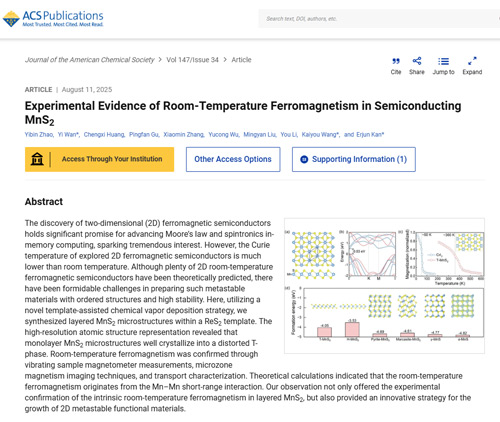 https://pubs.acs.org/doi/10.1021/jacs.5c10107
Pioneering Discovery in 2D Ferromagnetic Semiconductors
The discovery of 2D ferromagnetic semiconductors has raised great expectations for advancing Moore’s Law and spintronics in memory and computation. However, most explored 2D ferromagnetic semiconductors exhibit Curie temperatures far below room temperature. Despite theoretical predictions of many potential room-temperature 2D ferromagnetic materials, the experimental synthesis of ordered and stable metastable structures remains a formidable challenge.
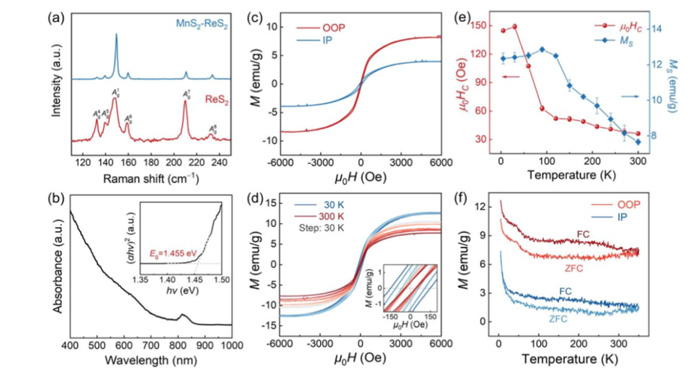
In this study, the researchers developed a template-assisted chemical vapor deposition (CVD) method to synthesize layered MnS₂ microstructures within a ReS₂ template. High-resolution atomic characterizations revealed that the monolayer MnS₂ microstructure crystallized well in a distorted T-phase. The optical bandgap and temperature-dependent carrier mobility confirmed its semiconducting nature.
By combining vibrating sample magnetometry (VSM), electrical transport measurements, and micro-magnetic imaging using CIQTEK SNVM, the team provided solid experimental evidence of room-temperature ferromagnetism in MnS₂. Electrical transport measurements also revealed an anomalous Hall resistance component in the monolayer samples. Theoretical calculations further indicated that this ferromagnetism originates from short-range Mn–Mn interactions.
This work not only confirms the intrinsic room-temperature ferromagnetism of layered MnS₂ but also proposes an innovative approach for the growth of metastable functional 2D materials.
Two Key Breakthroughs
-
Intrinsic Room-Temperature Ferromagnetism in MnS₂ Monolayers:
The study experimentally demonstrates intrinsic room-temperature ferromagnetism in semiconducting MnS₂, resolving the long-standing conflict between semiconductivity and magnetism. -
Template-Assisted CVD Strategy for Metastable Ferromagnetic Microstructures:
The developed synthesis strategy enables scalable fabrication of metastable ferromagnetic microstructures.
These advances establish MnS₂ as a model platform for 2D spintronics, offering a new pathway for engineering low-dimensional magnetic materials.
ChatGPT 说:
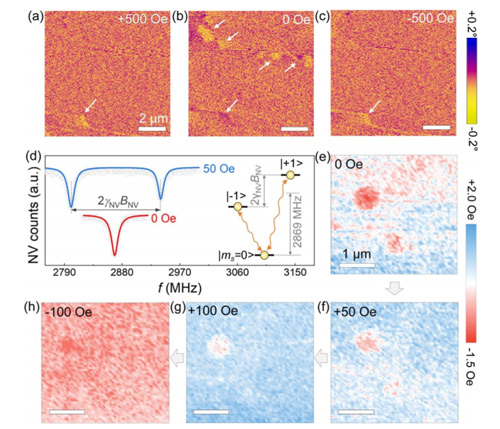
Figure 2: Micro-Region Magnetic Imaging
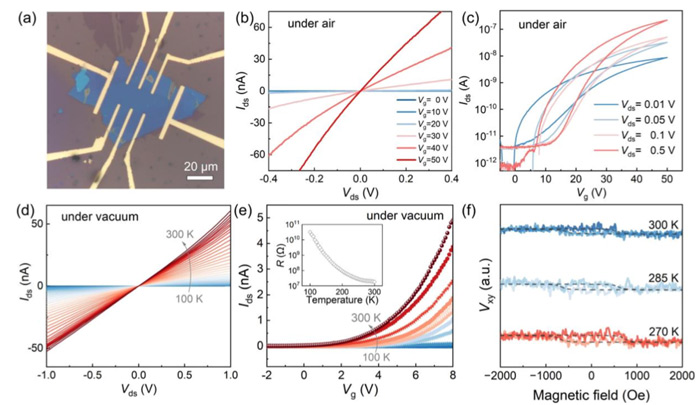 Figure 3: Electrical Transport Measurements
CIQTEK SNVM: Key Instrument Behind the Discovery
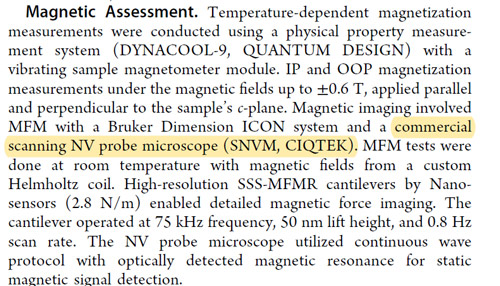
The CIQTEK Scanning NV Microscope (SNVM) played a crucial role in this research. Its high-precision nanoscale magnetic imaging capabilities were essential for visualizing and confirming the magnetic properties of MnS₂. This study highlights how CIQTEK's advanced scientific instruments are empowering frontier research in materials science and condensed matter physics.
This breakthrough not only drives progress in 2D material studies but also opens new opportunities for spintronics and next-generation memory technologies.
Experience CIQTEK SNVM
CIQTEK SNVM is a world-leading nanoscale magnetic field imaging system, offering:
-
Temperature range: 1.8–300 K
-
Vector magnetic field: 9/1/1 T
-
Magnetic spatial resolution: 10 nm
-
Magnetic sensitivity: 2 μT/Hz¹ᐟ²
Based on NV center-based optically detected magnetic resonance (ODMR) and atomic force microscopy (AFM) scanning imaging, the SNVM provides high spatial resolution, high magnetic sensitivity, multifunctional detection, and non-invasive measurement.
It is a powerful tool for magnetic domain characterization, antiferromagnetic imaging, superconductivity studies, and 2D magnetic materials research, enabling scientists to explore materials with high precision and confidence.