Selecting the right power supply for your LED strip lights is one of the most critical steps in any lighting installation. The power supply determines not only whether your LED strips perform optimally, but also how long they last and how much energy they consume. Many lighting failures and flickering issues stem from incorrect wattage calculation or unstable voltage output.
1. Understanding Power Supply Basics
LED strip lights operate on low DC voltage—typically 12V or 24V. The power supply (often called an LED driver) converts AC mains voltage (like 110V or 220V) into a steady DC output.
To choose the right one, you must calculate total power demand (W), current (A), and voltage (V) requirements.
| Parameter | Symbol | Description |
| Voltage | V | Operating voltage of the strip (12V / 24V) |
| Current | A | Flow of electric charge (amps) |
| Power | W | Energy consumption (watts = volts × amps) |
| Length | M | Total length of LED strip used |
2. Step-by-Step Power Calculation
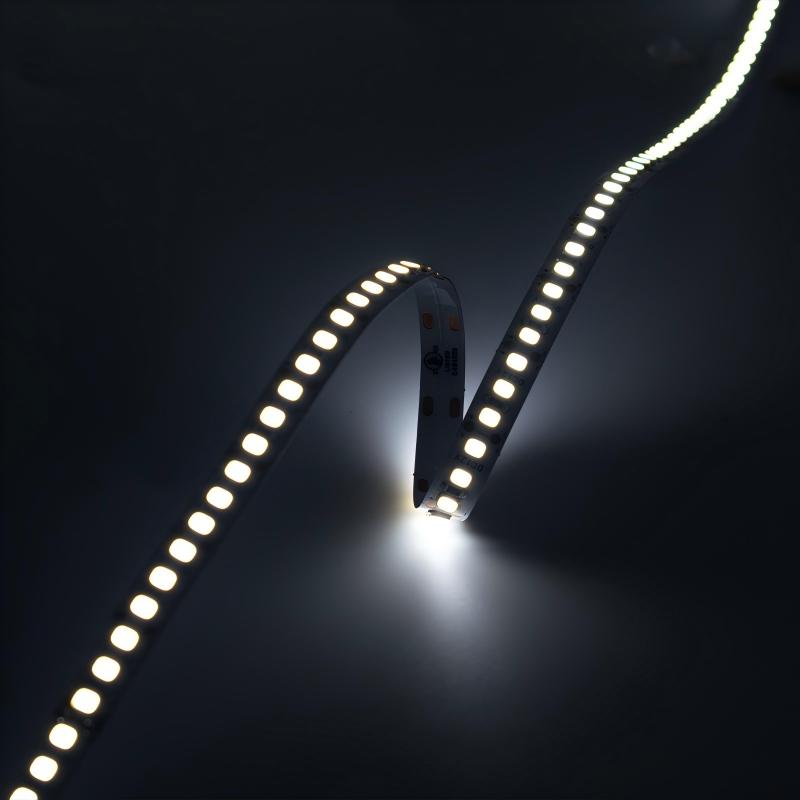
Let’s use a 240 LEDs/m LED Strip Light as an example.
Step 1: Identify the Rated Power per Meter
Manufacturers usually list power consumption like 19.2W/m or 24W/m.
Let’s assume your LED strip uses 20W/m at 24V.
Step 2: Multiply by the Total Length
If your project requires 5 meters:
Step 3: Add a Safety Margin
Always add 20–30% extra capacity to prevent overload and heat stress:
So, you’ll need a 24V / 125W (≈5.2A) power supply.
| Parameter | Value |
| Strip Voltage | 24V DC |
| Power per Meter | 20W |
| Length | 5m |
| Total Power | 100W |
| Safety Factor | +25% |
| Recommended Power Supply | 125W (5.2A) |
3. Voltage Drop and Efficiency Factors
For long runs (over 5m), voltage drop can cause visible brightness reduction toward the end of the strip. To prevent this:
-
Use thicker wires or feed power from both ends.
-
Choose 24V strips instead of 12V for better stability.
-
Split long strips into sections, each powered by its own connection.
| Wire Length | Recommended Wire Gauge (AWG) |
| <2m | 20 AWG |
| 2–5m | 18 AWG |
| 5–10m | 16 AWG |
4. Example: RGB LED Strip Power Calculation
For an Energy Saving RGB LED Strip Light, each color channel (R, G, B) consumes power.
A typical 24V RGB strip might draw 7.2W/m per color, totaling 21.6W/m.
Let’s say you install 10 meters:
So, you’ll need a 24V / 260W (≈10.8A) power supply.
| Parameter | Value |
| Strip Type | Energy Saving RGB LED Strip Light |
| Voltage | 24V DC |
| Power per Meter | 21.6W |
| Length | 10m |
| Total Power | 216W |
| Safety Margin | 20% |
| Recommended PSU | 260W / 10.8A |
5. Key Considerations Before Purchase
✅ Check Output Voltage — Match 12V or 24V exactly.
✅ Choose Proper Wattage — At least 20% above total load.
✅ Look for Certifications — CE, RoHS, UL ensure safety and efficiency.
✅ Mind Cooling — Ensure airflow around power supplies.
✅ Select Trusted Brands — Quality directly affects LED lifespan.
6. Recommended Setup Example
For a modern interior project using 240 LEDs/m LED Strip Light or Ultra Bright LED Strip Light Tape:
-
Length: 8 meters
-
Total Power: 8 × 20W = 160W
-
Recommended PSU: 24V / 200W switching supply
-
Efficiency: 88%
-
Energy Savings: Up to 30% vs. traditional neon lighting
The same power supply can also support Energy Saving RGB LED Strip Light for decorative accents if total power draw remains within 80% of PSU capacity.
Proper power calculation ensures your LED strips run efficiently, stay bright, and last longer. Whether you’re designing architectural lighting or setting up Energy Saving RGB LED Strip Light systems for homes and retail spaces, always size your power supply with care — it’s the hidden foundation of every reliable lighting installation.