Dimming is one of those details that can look simple on a lighting schedule but become much more complicated during installation.
A magnetic track lighting system may include the same track, the same type of light fixtures, and the same LED technology, yet the control system behind them can be completely different. One project may only need a wall dimmer, while another may require centralized control, multiple lighting zones, or individual fixture adjustment.
TRIAC, 0-10V, and DALI are three common approaches to LED dimming. They can all provide brightness control, but they do it in very different ways.
Understanding those differences helps designers, contractors, and buyers select the right LED drivers and avoid compatibility problems later.

Dimming Is More Than Adjusting Brightness
When people talk about dimming, the first thing they usually think about is brightness.
Technically, however, the important question is how the brightness is being controlled.
The control signal needs to reach the LED driver, and the driver needs to translate that signal into an appropriate output for the LED light source. This means that the dimmer, driver, and light fixture are part of one system.
For magnetic track lighting, the relationship can be simplified as:
AC Power → LED Driver → Magnetic Track → LED Fixture
The dimming control interacts with the driver:
Dimming Control → LED Driver → Magnetic Track → LED Fixture
Change the dimming method, and the driver may need to change as well.
This is why specifying a “dimmable magnetic track light” without defining the dimming method can leave an important part of the lighting system unresolved.
TRIAC Dimming: A Straightforward Approach
TRIAC dimming is based on phase-cut control. Instead of continuously supplying the full AC waveform to the LED driver, the dimmer cuts part of each AC cycle. The compatible driver interprets this changing input and adjusts the LED output accordingly.
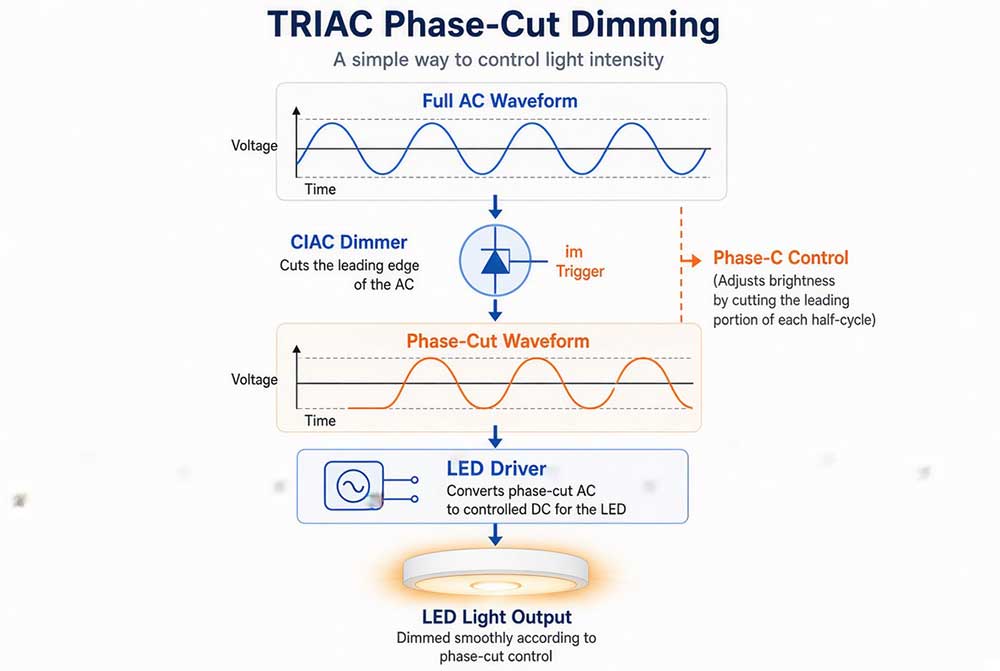
For many smaller projects, this approach is attractive because the user experience is familiar: a wall-mounted dimmer controls the lighting in much the same way people are accustomed to controlling conventional lighting.
Consider a residential project with magnetic spotlights over a kitchen island and linear lights along a living room ceiling. If the owner only wants to adjust the overall brightness from a wall control, there may be little reason to introduce a more complex digital control system.
TRIAC can also work well when a project is designed around existing AC dimming infrastructure.
The important word here is compatible.
An LED driver designed for TRIAC dimming still needs to work correctly with the selected dimmer. Two different TRIAC dimmers can produce different results with the same driver.
At high brightness, the system may appear perfectly stable. As the dimming level decreases, however, problems can become more noticeable. Flickering, dead zones, sudden shut-off, or an inability to reach a low brightness level can all indicate that the driver and dimmer combination needs closer attention.
For this reason, TRIAC performance should be evaluated as a system rather than based only on the label printed on the driver.
When TRIAC Makes Sense
TRIAC is generally worth considering when:
- The project uses wall-mounted AC dimmers.
- Simple local brightness control is enough.
- The electrical installation does not require a more advanced lighting network.
- A compatible TRIAC-dimmable driver is available and has been verified with the intended dimmer.
It is a practical solution when the lighting control requirements are relatively straightforward.
0-10V Dimming: Separating Power From Control
0-10V takes a different approach.
Instead of using phase-cut control on the AC input, the LED driver receives a separate low-voltage control signal. The signal level determines the desired lighting output.
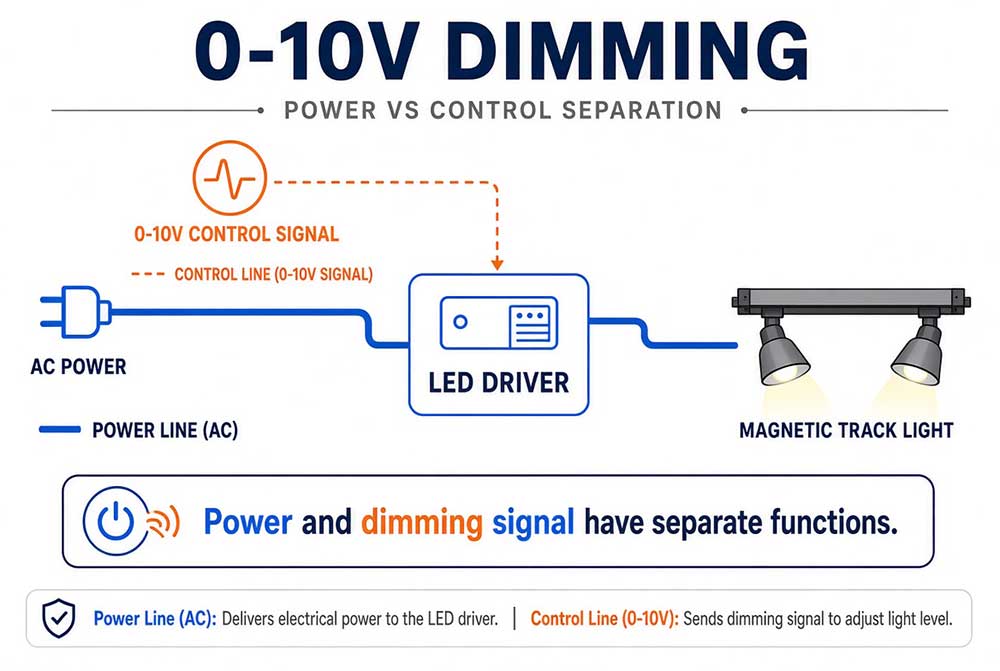
This separation between power and control makes 0-10V particularly useful in commercial lighting.
Imagine an office with several groups of magnetic track lights. The lighting above workstations may need one brightness level, while decorative lighting in a reception area needs another. A centralized controller can send different 0-10V signals to different lighting zones.
The concept is still relatively easy to understand, but the installation needs to account for the additional control wiring.
This is one reason why 0-10V is best considered during the design stage. If the project is already installed with only power wiring and later changes to 0-10V, adding the required control connections may create unnecessary work.
Another point worth clarifying is that 0-10V and 1-10V are not automatically the same thing. They are related analog control methods, but their control behavior and requirements can differ depending on the driver and control equipment. A specification should identify the actual control standard required rather than treating the terms as interchangeable.
Where 0-10V Fits Best
0-10V can be a strong option when the project needs practical commercial dimming without requiring the full functionality of a digital addressable system.
It is commonly considered for spaces such as:
Retail stores → Offices → Hospitality spaces → Commercial interiors
The specific application will depend on the project's electrical and control design.
DALI: Turning Dimming Into Digital Control
DALI stands apart from TRIAC and 0-10V because it is designed around digital communication.
With compatible equipment, the control system can communicate with individual lighting devices rather than simply sending a general dimming level.
This difference becomes much more important as a project becomes more complex.
Suppose a hotel lobby has dozens of magnetic track lights. During normal operation, several groups may need to operate together. During an event, some decorative fixtures may need to be dimmed while other areas remain bright. A cleaning scene may require another lighting configuration altogether.
With a simple dimming arrangement, creating these different control relationships can become difficult.
A DALI-based system can provide a more structured way to address fixtures and organize them into groups or scenes, depending on the equipment and control system being used.
This is one of DALI's biggest strengths: the lighting system can be treated as a collection of controllable devices rather than simply one circuit.
That additional flexibility comes with additional planning. DALI drivers, control devices, wiring, commissioning, and system configuration all need to work together.
So DALI should not be selected simply because it offers more functions. Its value comes from having a project that actually needs those functions.
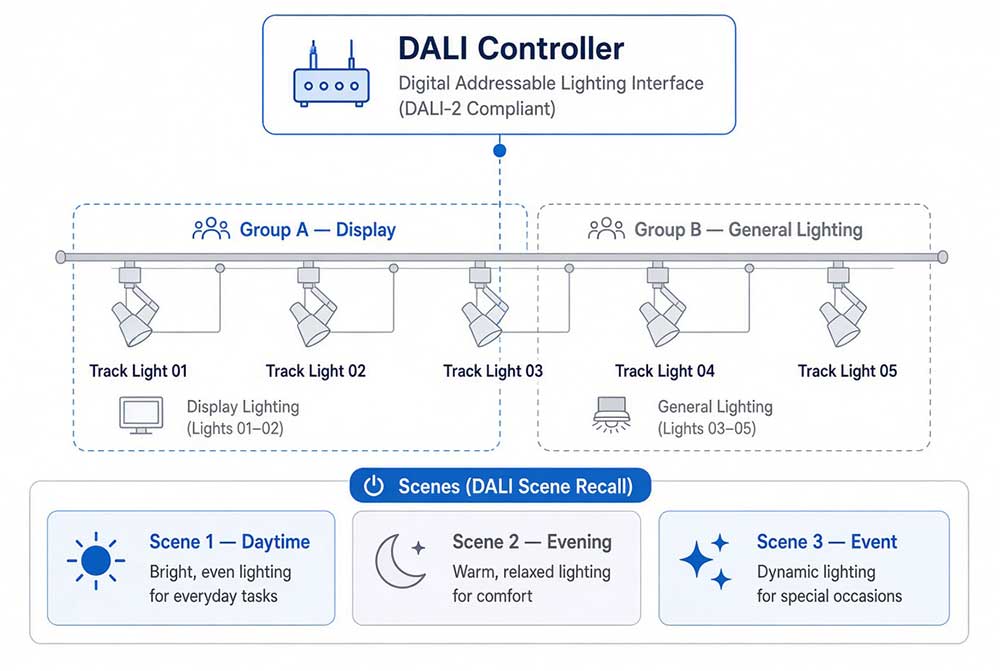
The Difference Becomes Clearer at Project Level
It is easier to understand the three systems by imagining how the lighting project grows.
A small apartment may only need one control point. The user adjusts the lights manually and does not care which individual fixture is at 70% and which is at 50%.
A retail store may have several zones and require different brightness levels throughout the space. Centralized control becomes more useful.
A hotel, gallery, or large architectural project may require individual fixture addressing, groups, scenes, scheduling, or integration with other control systems.
The physical lighting products may look similar in all three projects. The control requirements are what change.
| Project situation | Dimming approach to consider |
| Simple local brightness adjustment | TRIAC |
| Existing AC wall dimmer infrastructure | TRIAC |
| Commercial zoned control | 0-10V |
| Centralized analog dimming | 0-10V |
| Individual fixture addressing | DALI |
| Multiple groups and lighting scenes | DALI |
| More advanced digital lighting management | DALI |
This should be treated as a starting point rather than a universal rule. The actual driver specifications and control architecture always need to be checked.
Driver Compatibility Is the Part You Cannot Skip
A common mistake in lighting projects is to select the dimming method and then choose a driver afterward.
The process is safer when these decisions are made together.
For example, a project may specify: “Magnetic track lighting, TRIAC dimmable.”
That sounds complete, but several questions remain.
Which TRIAC dimmer will be used? What is the driver's minimum load? What dimming range is expected? Does the driver behave correctly with that dimmer at low output? What happens when multiple drivers are connected to the same control?
The same questions apply to 0-10V and DALI systems.
For a dimmable magnetic track lighting project, the driver specification should normally confirm:
- Input voltage
- Output voltage
- Rated power
- Load range
- Dimming method
- Dimming range
- Minimum load, where applicable
- Control wiring requirements
- Compatibility with the intended control equipment
The more complex the project becomes, the more important this coordination becomes.
Low-End Dimming Deserves Special Attention
A lighting system that dims from 100% to 50% smoothly may still perform poorly between 20% and 5%.
This is particularly relevant in hospitality, residential, and decorative applications where very low light levels are part of the intended atmosphere.
Imagine a restaurant where the lighting needs to move gradually from bright service lighting to a much lower evening level. If the lights suddenly flicker or switch off when the dimming level reaches 10%, the problem is not simply that “the lights are dimmable.”
The real question is whether the complete driver and control system can achieve the required dimming range reliably.
When evaluating a dimmable magnetic track lighting system, it is therefore useful to look beyond the word “dimmable” and ask for actual dimming performance.
Wiring Can Influence the Choice
The dimming method also affects how the electrical installation is planned.
TRIAC control is generally associated with controlling the AC input, while 0-10V and DALI use dedicated control connections according to the system design.
This difference may seem small when looking at an individual driver, but it becomes important when designing an entire project.
A lighting designer may already know where the tracks will be installed, how many control zones are required, and where the control panels will be located. Those decisions can determine how the power and control wiring need to be routed.
This is why changing the dimming method late in a project can be inconvenient. The lighting fixture may remain the same, but the driver, control wiring, and control equipment may not.
One Track Does Not Always Mean One Control Zone
Magnetic track lighting is flexible because multiple fixtures can share the same track system. But that does not necessarily mean every fixture needs to respond to the same dimming command.
A retail display may need one group of spotlights to highlight products while another group provides general illumination.
A gallery may want different sections of the track to respond independently.
A hospitality project may require separate scenes for different times of day.
Before choosing the dimming method, it is worth deciding whether the project needs:
One control zone → Several zones → Group control → Individual fixture control
This simple distinction can narrow down the appropriate control architecture very quickly.
TRIAC, 0-10V, and DALI Are Not Really Competitors
It is tempting to ask which one is “better,” but that is not quite the right comparison.
TRIAC is useful when the priority is straightforward local dimming.
0-10V can make sense when a commercial project needs practical analog control across several zones.
DALI becomes more valuable when the lighting system needs digital communication, addressing, grouping, and more advanced control.
The best solution is therefore the one that matches the project's requirements without adding unnecessary complexity.
A simple room does not become better because it uses a sophisticated lighting control system. At the same time, a large architectural project can become unnecessarily difficult to manage if it is built around a control method that was never designed for that level of flexibility.
A Practical Selection Process
Rather than choosing a dimming technology based on a product label, start with the intended lighting experience.
First, determine how the user will control the lights. Is it a wall dimmer, centralized panel, smart control system, or something more advanced?
Next, determine how many control zones are required. One room with one control zone is very different from a building with dozens of independently controlled areas.
Then consider whether individual fixture addressing or scene control is needed.
Finally, select the LED driver and control equipment that support the chosen method and verify their compatibility before installation.
This approach keeps the decision connected to the actual project instead of choosing a technology simply because it appears on a specification sheet.
Common Dimming Mistakes to Avoid
Some problems can be prevented before the first light is installed.
Choosing a dimmer without checking the driver.
A dimmer and driver should be treated as a matched system, particularly with TRIAC applications.
Assuming every “dimmable” product supports the same dimming method.
Dimmable does not mean universally compatible. The specific control method should always be confirmed.
Ignoring the required minimum brightness.
If a project needs very low light levels, the actual dimming range matters just as much as full-output performance.
Adding control requirements too late.
0-10V and DALI systems can affect wiring and system architecture, so they should be considered before installation.
Using an advanced system where simple control is enough.
More functionality is not automatically more suitable. The system should match the project's real requirements.
FAQ
Can magnetic track lighting use TRIAC, 0-10V, or DALI?
Yes. Magnetic track lighting can be configured with different dimming methods depending on the LED driver and control system. The track itself does not automatically determine the dimming technology.
Which dimming method provides the smoothest dimming?
There is no universal answer. Dimming performance depends on the driver, control device, LED load, and system configuration. The specified dimming method should be evaluated together with the actual driver and control equipment.
Can a TRIAC-dimmable driver be used with any TRIAC dimmer?
Not necessarily. Compatibility varies between driver and dimmer models. Testing or manufacturer compatibility information should be used when reliable low-level dimming is important.
Does 0-10V require additional wiring?
Typically, yes. A 0-10V system uses a separate low-voltage control signal in addition to the power connection, so the wiring arrangement should be considered during electrical planning.
Is DALI too complicated for a small project?
It can be unnecessary for a project that only needs basic local dimming. However, the suitability depends on whether the additional control capabilities provide real value for the application.