Nuclear fusion is considered a key future energy source due to its high efficiency and clean energy output. In fusion reactors, water cooling systems are widely used because they are technically mature, cost-effective, and have excellent cooling performance.
However, a major challenge remains: under high temperature and high pressure, water and steam strongly corrode structural materials. While this problem has been studied in fission reactors, fusion environments are more complex. The unique high-intensity, unevenly distributed magnetic fields in fusion devices interact with corrosion processes, creating new technical challenges that need detailed research.
To address this, Associate Professor Peng Lei's team from the University of Science and Technology of China conducted an in-depth study using the CIQTEK scanning electron microscope (SEM) and dual-beam electron microscope. They built high-temperature magnetic-field steam corrosion and high-temperature water corrosion setups. Using SEM, EBSD, and FIB techniques, they analyzed oxide films formed on CLF-1 steel after 0–300 hours of steam corrosion at 400°C under 0T, 0.28T, and 0.46T magnetic fields, and after 1000 hours of high-temperature water corrosion at 300°C.
 The study used CIQTEK SEM5000X ultra-high-resolution field-emission SEM and the FIB-SEM DB500
The study found that the oxide films form a multilayer structure, with a chromium-rich inner layer and an iron-rich outer layer. Film formation occurs in five stages: initial oxide particles, then floc-like structures, formation of a dense layer, growth of spinel structures on the dense layer, and finally, spinel cracking into laminated oxides. The presence of a magnetic field significantly accelerates corrosion, promotes the transformation of outer magnetite (Fe₃O₄) into hematite (Fe₂O₃), and enhances laminated oxide formation. This work was published in Corrosion Science, a top-tier journal in the field of corrosion and materials degradation, under the title: "Magnetic field effects on the high-temperature steam corrosion behavior of reduced activation ferritic/martensitic steel."

Surface Oxide Film Characterization
In high-temperature steam (HTS), CLF-1 steel surfaces show different corrosion states over time. On polished surfaces, early-stage oxidation (60 h) appears as small, dispersed particles. The Fe/Cr ratio is similar to the substrate, indicating that the oxide layer is not yet complete. By 120 h, floc-like oxides appear. At 200 h, a dense oxide layer forms, with new oxide particles and local spinel structures on top.
Rough surfaces corrode faster. Early floc-like oxides are finer and more evenly distributed. By 200 h, they transform into spinel structures, showing a stronger difference from polished surfaces. In high-temperature, high-pressure water (HTPW), polished surfaces display similar spinel structures. Spinel in HTPW is denser and more numerous, while spinel in HTS is larger in size.
When a magnetic field is applied (0.28 T on polished, 0.46 T on rough), corrosion changes further. After 60 h, oxide particles appear on both surfaces, more on rough surfaces. By 120 h, polished surfaces have particle-like oxides, while rough surfaces develop fine floc-like films. At 200 h, rough surfaces show spinel cracking and layered structures perpendicular to the surface, with many pores forming. By 240 h, layers become denser and well-aligned. EDS analysis shows that under magnetic fields, Fe/Cr decreases and oxygen increases over time. Cr content drops at 120 h, earlier than in non-magnetic conditions, showing that magnetic fields accelerate the formation of the iron-rich outer layer.
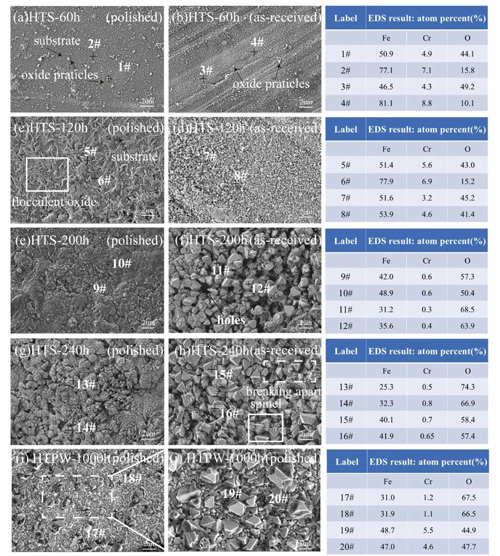 Figure 1. SEM images and EDS point scans (#1–#20) of CLF-1 surfaces under HTS and HTPW.
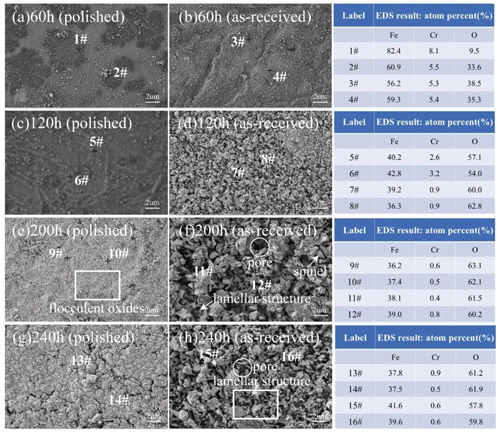 Figure 2. SEM images and EDS point scans (#1–#16) of CLF-1 surfaces exposed to magnetic fields: polished (0.28 T), rough (0.46 T).
Oxide Film Phase Analysis
Figures 3 and 4 show Raman spectra of CLF-1 steel oxide films in HTS, HTPW, and under magnetic fields. Without a magnetic field, films in both HTS and HTPW are mainly spinel structures composed of Fe₃O₄ and FeCr₂O₄. The Raman peaks (302, 534, 663, 685 cm⁻¹) overlap, making differentiation difficult. Hematite (Fe₂O₃) appears only on rough HTS surfaces after 240 h.
Under a magnetic field, oxidation accelerates. Polished surfaces show small Fe₂O₃ peaks only at 240 h, while rough surfaces show Fe₂O₃ as early as 120 h, increasing by 240 h. Meanwhile, Fe₃O₄ and FeCr₂O₄ peaks weaken, indicating faster hematite formation.
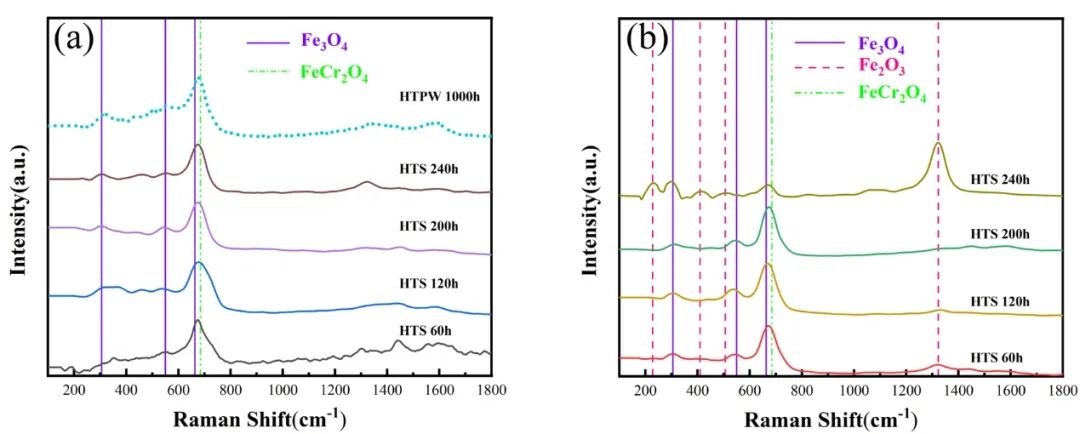 Figure 3. Raman spectra of oxide films on CLF-1 under HTS and HTPW: (a) polished; (b) rough.
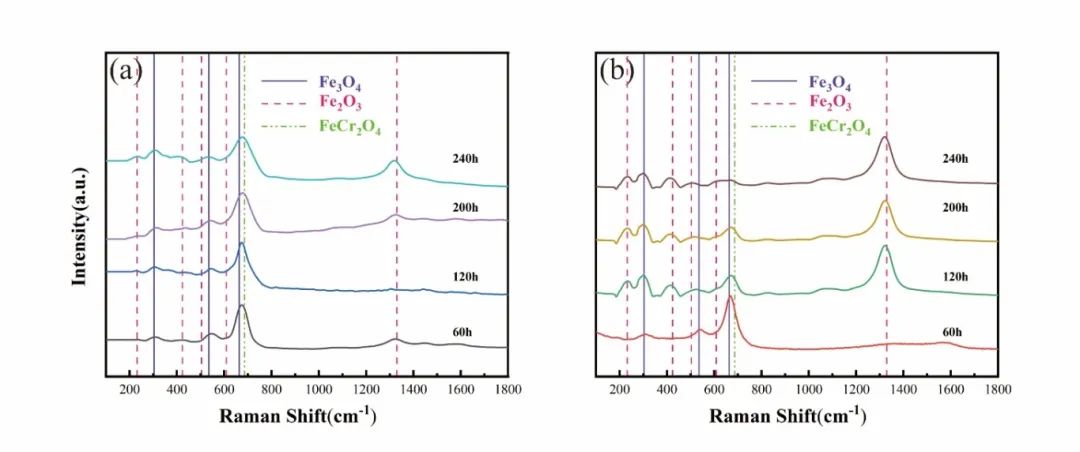 Figure 4. Raman spectra under magnetic field HTS: (a) polished (0.28 T); (b) rough (0.46 T).
Cross-Section Oxide Film Characterization
EBSD analysis of rough surfaces after 300 h HTS corrosion (Figure 5a, b) shows a three-layer oxide structure: a thin, discontinuous Fe₂O₃ outer layer, a dense Fe₃O₄ middle layer, and a black chromium-rich layer between Fe₃O₄ and the substrate. FIB-prepared cross-sections (Figure 5c, d) and TEM/SAED analysis confirm that the chromium-rich layer is FeCr₂O₄, and the iron-rich layer is Fe₃O₄. Gaps at the interfaces indicate phase separation and pore formation during oxidation evolution.
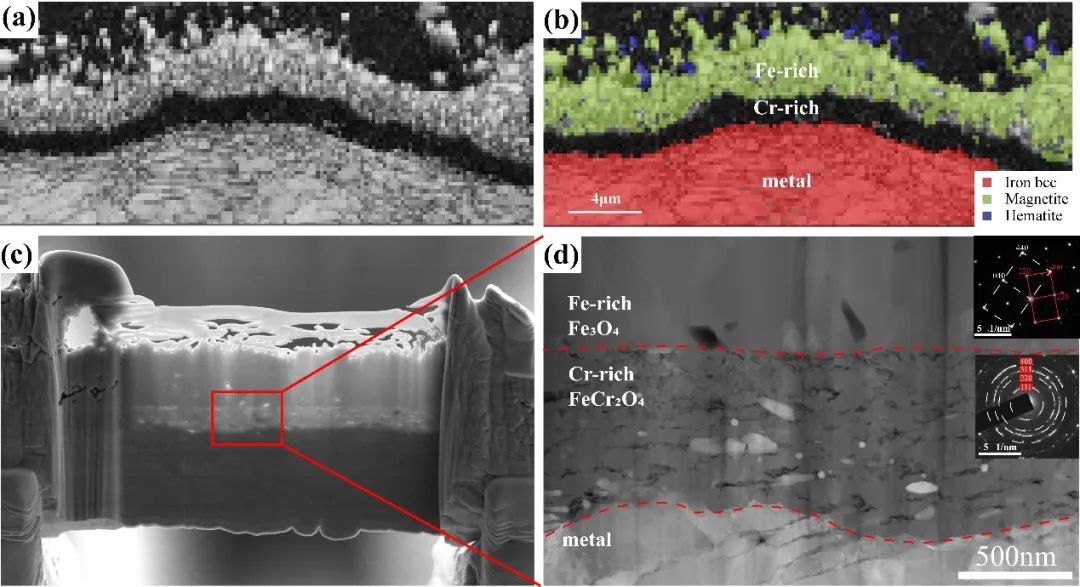 Figure 5. Microstructure and phase distribution of cross-section oxide films on rough CLF-1 surfaces after 300 h HTS: (a) EBSD contrast; (b) EBSD phase map; (c) FIB cross-section; (d) dark-field TEM and SAED.
Figure 6 shows cross-sections under a magnetic field (HTS, 240 h). EBSD shows outer oxides composed of Fe₃O₄ and Fe₂O₃. Fe₃O₄ layers are vertically aligned with many pores, and Fe₂O₃ fills surface gaps. The chromium-rich layer between the outer layer and substrate is porous. Compared with non-magnetic conditions, films are looser with more pores, especially at layer interfaces and within the Fe-rich layer. SAED confirms that oxide films still consist of FeCr₂O₄ and Fe₃O₄ from inner to outer layers. Magnetic fields mainly affect film density and pore evolution, not phase composition.
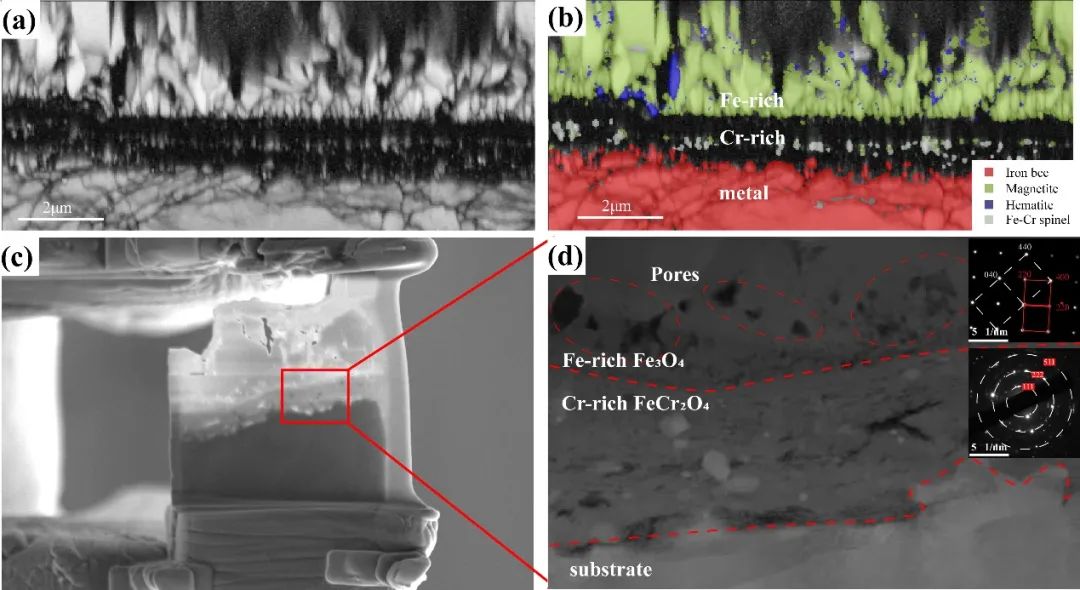 Figure 6. Cross-section microstructure and phase distribution of rough CLF-1 surfaces under magnetic field HTS: (a) EBSD contrast; (b) EBSD phase map; (c) FIB cross-section; (d) dark-field TEM and SAED.
This study examines the effect of magnetic fields on CLF-1 steel corrosion after 300 h in 400°C HTS. It also compares oxide films formed under HTPW and HTS conditions. The findings provide important reference data for optimizing the corrosion resistance of fusion structural materials.